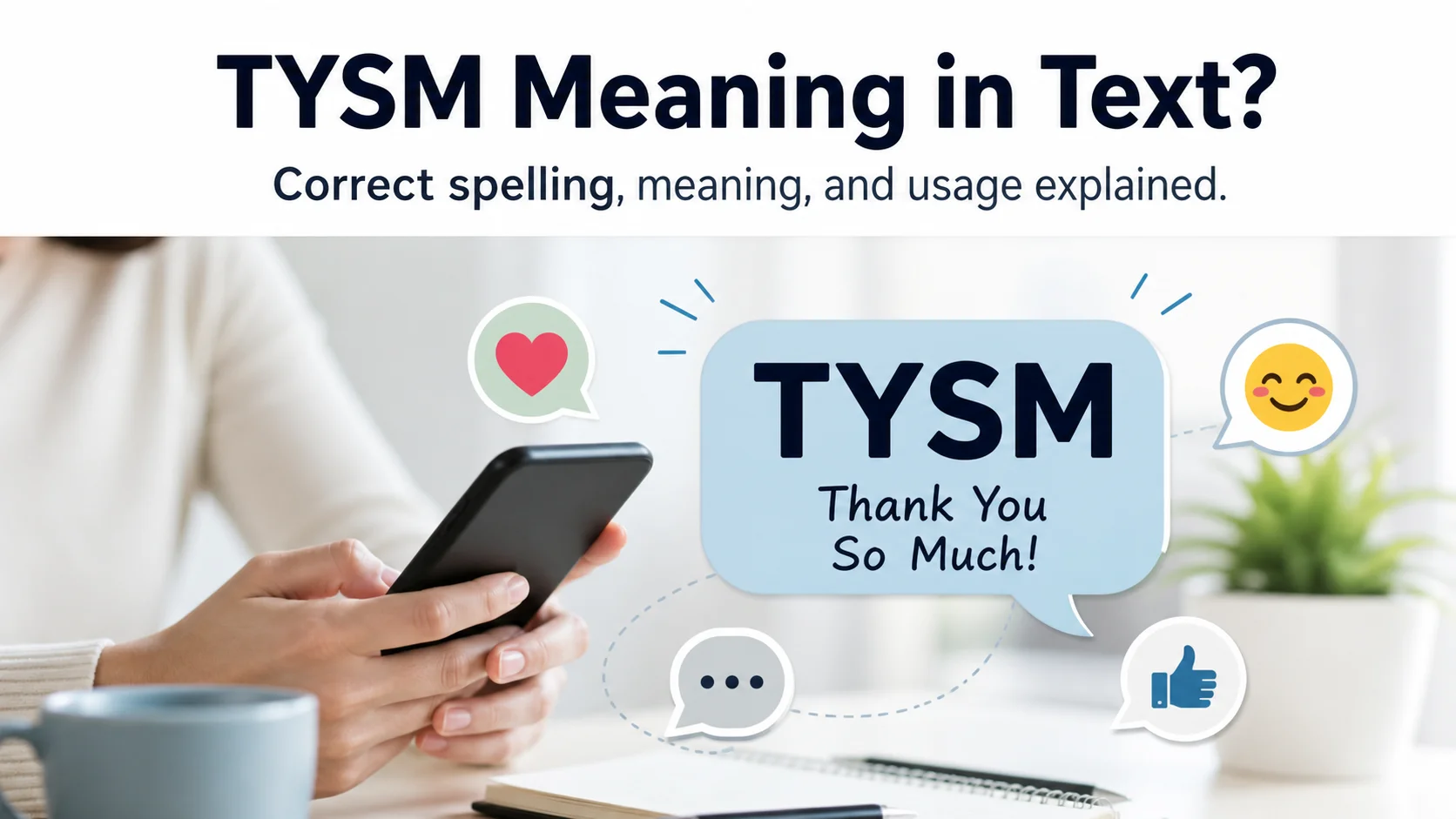
TYSM Meaning in Text is commonly used in modern digital communication where people prefer short forms instead of long messages. If you have ever wondered what does TYSM mean in text, you are not alone. It simply shows gratitude in a quick way. Instead of writing full thank-you notes, users now rely on texting slang, especially in Gen Z chats, where speed and simplicity matter most in everyday conversations.
I’ve noticed in casual chats, professional messages, and even late-night memes that TYSM often appears when someone wants to show appreciation. It can feel confusing at first, especially when you see many acronyms online that change with context. The meaning can slightly vary, but it is mostly used to express a warm thank you. Once you understand it, you can respond easily and avoid awkward confusion in fast-moving online conversations.
TYSM Meaning in Text: Simple Definition
TYSM = Thank You So Much.
That is the core meaning, and it is the meaning most people intend when they type it in a text message or social post. Collins labels TYSM as an abbreviation used in messaging and social media, and Wiktionary also lists it as internet and text-messaging slang.
Here is the simplest way to think about it:
- TY = thank you
- TYSM = thank you so much
- TYVM = thank you very much
TYSM usually feels warmer than TY. It also sounds more grateful than a bare “thanks.” That makes it a useful middle ground when you want to sound appreciative but still keep the message short. This is an interpretation based on how the phrase functions in everyday use and on the fact that it expands to a stronger gratitude phrase.
Quick definition table
| Term | Full meaning | Typical tone | Best use |
| TY | Thank you | Short, casual | Quick acknowledgment |
| TYSM | Thank you so much | Warm, appreciative | Friendly texts, DMs, comments |
| TYVM | Thank you very much | Polite, slightly more formal | General gratitude |
| Thanks | Thanks | Neutral to casual | Everyday conversation |
| Thank you so much | Thank you so much | Warm, clear, direct | Any situation where clarity matters |
TYSM works because it trims the message down to its emotional core. You do not need a long speech when a short, sincere thank-you will do. In texting culture, that kind of efficiency is normal. Texting itself is built around short messages sent quickly through mobile devices, and online language has long favored abbreviations for exactly that reason.
What TYSM Really Communicates Beyond the Words
On the surface, TYSM just means thank you so much. In real conversations, though, it often carries a little extra meaning.
It can signal:
- genuine appreciation
- warmth
- relief
- friendliness
- respect
- soft enthusiasm
That last point matters. Someone can type “thanks” and sound fine. Someone can type TYSM and sound a little more emotionally engaged. The phrase feels more expressive because it includes “so much,” which adds weight to the thank-you. That is an inference from the phrase’s structure and its use in messaging contexts.
Think of it like this:
“Thanks” is a nod.
“TYSM” is a smile and a nod.
Not every message needs a full emotional performance. Sometimes a simple shorthand is the best choice. TYSM gives you that shortcut without sounding cold.
Why People Use TYSM Instead of Writing the Full Phrase
People use TYSM for the same reason they use other texting shortcuts: it saves time and keeps the conversation moving. Texting and instant messaging are designed for fast, back-and-forth communication, and internet language often develops abbreviations to match that pace. Cambridge’s language resources describe internet language as containing forms like abbreviations, and scholarship on online communication has long noted the growth of chat-style shorthand.
Here are the main reasons TYSM survives:
1. It is fast
You can send it in one breath. No extra typing. No overthinking.
2. It feels friendly
TYSM sounds warmer than a plain “ok” or “got it.”
3. It fits mobile communication
Texting usually happens in short bursts. A compact phrase fits the format well. Britannica describes texting as sending short messages with cell phones, which helps explain why short forms stay popular.
4. It works in public and private chats
You can use it in direct messages, group chats, and comment replies without making the interaction feel heavy.
5. It matches modern online tone
Digital communication often mixes speed with emotion. TYSM gives you both.
Where TYSM Is Commonly Used Online
TYSM appears most often where people communicate quickly and casually. That includes messaging apps, social media comments, and informal group chats. Current dictionary sources place it squarely in messaging and social media use, which matches its real-world behavior.
Common places you will see TYSM
- Instagram DMs
- Snapchat chats
- Messenger
- Discord
- TikTok comments
- X replies
- Group chats
- Community forums
These settings share one thing in common: speed matters. People want to respond quickly without sounding rude. TYSM solves that problem neatly.
Why TYSM feels natural in these spaces
- Messages are short.
- Replies happen fast.
- Tone matters more than polished grammar.
- People often use abbreviations to keep the flow light.
That pattern fits what researchers and language references say about online communication. Internet language grows in chat-heavy spaces, and texting favors short, compressed forms.
TYSM Meaning in Different Contexts
The same abbreviation can feel slightly different depending on where you use it. That is true for a lot of text slang, and TYSM is no exception.
1. With friends
This is the easiest setting. TYSM feels natural when a friend helps you, shares a link, gives advice, or comes through for you.
Example:
“TYSM for sending the notes. You saved me.”
Here the phrase feels warm and personal. It sounds like real appreciation, not a scripted reply.
2. In online communities
TYSM works well in public replies, especially when someone shares help, tips, or encouragement.
Example:
“TYSM, this guide made everything clearer.”
That kind of reply sounds friendly and relatable.
3. In customer service situations
A customer might use TYSM to thank a support agent, or an agent might use it in a polite but casual reply.
Example:
“TYSM for your patience.”
This can sound kind and human. Still, tone matters. In a formal support setting, a full “thank you so much” may sometimes feel safer.
4. In workplace chats
TYSM may work in informal Slack or Teams messages, especially when the team already uses relaxed communication. But it can feel too casual in formal emails or when writing to a new manager. That recommendation is based on tone and standard workplace etiquette rather than a dictionary rule.
5. In creator-audience interactions
TYSM shows up often when people thank followers, fans, or commenters.
Example:
“TYSM for the support on my last post.”
This feels friendly and current. It also matches how social media rewards short, emotional responses.
How to Use TYSM Correctly in Sentences
TYSM can stand alone or sit inside a longer sentence. Both styles work.
1. As a full reply
This is probably the most common form.
Example:
“TYSM!”
It says everything in one tiny package.
2. At the start of a message
This feels direct and appreciative.
Example:
“TYSM for helping me figure that out.”
3. In the middle of a sentence
You can use it when you want a message to feel casual and smooth.
Example:
“I just wanted to say TYSM for your help yesterday.”
4. At the end of a message
This often feels the most natural in a longer text.
Example:
“I really appreciate the ride home, TYSM.”
5. With emojis
Emojis can soften the tone and add warmth.
Example:
“TYSM
“TYSM
“TYSM
Emoji use is not required, but it can help when you want the message to feel more personal. That is an inference from common messaging style, not a strict rule.
TYSM Examples That Sound Natural
A lot of slang guides stop at the definition. That is not enough. Real usage matters more than memorizing an acronym.
Here are examples that sound like real messages:
- “TYSM for the birthday gift. I love it.”
- “TYSM for replying so fast.”
- “TYSM, that link helped a lot.”
- “TYSM for covering for me.”
- “TYSM! I was completely stuck.”
- “TYSM for the invite. I had a great time.”
- “TYSM, this makes way more sense now.”
Notice the pattern. TYSM usually appears when somebody wants to thank another person for something useful, kind, or thoughtful. That makes it more than a placeholder. It becomes a tiny relationship signal.
Mini grammar note
TYSM is not a sentence by itself in the traditional sense. It is an abbreviation used as an interjection or message fragment in digital conversation, which fits its role in text-based communication. Cambridge describes acronyms and initials as forms built from initial letters, and Wiktionary treats TYSM as an internet-slang initialism.
Tone and Emotion Behind TYSM
Tone is where TYSM becomes interesting.
The phrase usually sounds:
- polite
- friendly
- grateful
- casual
- light
- approachable
It does not usually sound dramatic. It does not sound formal either. Instead, it sits in a comfortable middle zone. That is one reason people like it so much.
How TYSM compares with other thank-you phrases
- Thank you sounds clear and universal.
- Thanks sounds quick and casual.
- TYSM sounds warmer and more expressive.
- Thank you so much sounds the fullest and most explicit.
If you want to sound genuine without typing a long response, TYSM does the job. If you want more formality or depth, spell the phrase out.
A simple analogy
TYSM is like handing someone a handwritten note instead of a printed receipt. The message is still short, but it feels more human.
That is not a scientific definition. It is a practical way to understand the tone.
When TYSM Feels Perfect
TYSM works best when the situation is light, kind, and familiar.
Use it when:
- a friend helps you
- someone shares useful information
- a teammate does you a favor
- a creator or commenter gives support
- a casual chat needs a warm thank-you
- you want to reply quickly without sounding abrupt
Example situations
- A classmate sends homework notes.
- A coworker covers a small task.
- A friend gives you directions.
- A follower compliments your post.
- Someone answers your question in a group chat.
In all of these cases, TYSM feels natural because the interaction is already casual or friendly.
When TYSM Can Feel Too Casual
This is where judgment matters.
TYSM may feel too relaxed in places where the relationship is formal, the stakes are high, or the tone needs more care.
Avoid TYSM when:
- you are writing a formal email
- you are messaging a new client
- you are applying for a job
- you are responding in a serious complaint thread
- you are thanking someone in a highly professional setting
- you are dealing with sensitive or emotional matters
That advice is based on common communication norms, not on a dictionary rule. The word itself is not offensive. The issue is tone.
A quick example
A text like this works well:
“TYSM for helping with the event photos.”
But in a formal message, this may be better:
“Thank you so much for your help with the event photos.”
The difference is subtle, but important. One sounds relaxed. The other sounds polished.
TYSM vs. Other Thank-You Abbreviations
A lot of people use TYSM interchangeably with other short forms. They are similar, but not identical.
Comparison table
| Expression | Meaning | Tone | Best use |
| TY | Thank you | Very short, casual | Fast reply |
| TYSM | Thank you so much | Warm, friendly | Everyday gratitude |
| TYVM | Thank you very much | Polite, slightly formal | Neutral settings |
| THX | Thanks | Very casual | Quick text reply |
| TKS | Thanks | Brief, utilitarian | Fast, low-emotion reply |
| Thank you | Thank you | Clear and versatile | Broad use |
| Thank you so much | Thank you so much | Warm and full | When clarity matters |
TYSM vs TY
TY is shorter. TYSM is warmer.
If the help was minor, TY may be enough.
If the help mattered, TYSM usually feels better.
TYSM vs THX
THX is even more clipped. It can feel efficient, but it can also sound colder depending on the relationship.
TYSM vs “thank you so much”
Spelling it out creates more clarity. TYSM creates more speed. That tradeoff is the whole game.
TYSM vs TYVM
TYVM is polite and a little more formal. TYSM often sounds softer and more emotional.
Common Mistakes People Make With TYSM
Even simple slang can go sideways when people use it without thinking.
1. Using it in a formal email
This is the most common mistake. A hiring manager, professor, or new client may prefer full words.
2. Overusing it
When every message says TYSM, the phrase loses some of its punch. Gratitude should feel real, not copy-pasted.
3. Using it in the wrong tone
Sometimes the words are fine, but the moment feels off. For example, a very serious apology usually needs more than a quick abbreviation.
4. Assuming everyone knows the meaning
Many people do know TYSM. Some do not. In international or mixed-age groups, a full phrase may be safer.
5. Making the message too short
Sometimes a bare “TYSM” is enough. Other times it feels a bit thin. Adding a little context helps.
Better:
“TYSM for your help. I really appreciate it.”
That small extra line can make a big difference.
When You Should Avoid Using TYSM
TYSM is not bad language. It is just a tool. Like any tool, it works better in some places than in others.
Avoid TYSM in these situations
- formal job communication
- academic writing
- customer complaints that need seriousness
- legal or medical messages
- messages to someone who may not know slang
- first-time professional communication
Use the full phrase instead
- “Thank you so much for your time.”
- “Thank you so much for your support.”
- “I really appreciate your help.”
Why this matters
In high-stakes communication, clarity matters more than speed. Text shortcuts work best when the relationship is already established and the setting is relaxed.
Real Examples of TYSM in Everyday Conversations
Examples make slang easier to remember than definitions alone.
Example 1: Friend-to-friend
A: “I sent the screenshots.”
B: “TYSM, you’re the best.”
This feels natural because the conversation is informal and friendly.
Example 2: Group chat
A: “Here’s the meeting link.”
B: “TYSM, I almost missed it.”
This works well because it is short and useful.
Example 3: Social media reply
A: “Your playlist helped a lot.”
B: “TYSM, glad it helped.”
This sounds human and warm.
Example 4: Supportive comment
A: “Thanks for sharing this guide.”
B: “TYSM for reading it.”
This is a common social-media style reply.
Example 5: Work chat
A: “I updated the file.”
B: “TYSM, that saves me time.”
This can work in casual team spaces.
Mini Case Study 1: TYSM in a Friendship Chat
A person asks a friend for help finding a restaurant. The friend sends a link and a few directions. The reply is just “TYSM!”
Why does that work?
Because the situation is light, the favor is small, and the relationship is close. A short abbreviation shows gratitude without turning the exchange into a speech. It feels fast and sincere.
This is a good example of how texting language compresses meaning without destroying emotion. Texting is built around short messages, and abbreviations have grown naturally inside that system.
Mini Case Study 2: TYSM in a Customer Support Reply
A customer receives a refund or a quick solution from support. They reply with “TYSM for resolving this so fast.”
Why does that work?
Because it shows appreciation while keeping the tone friendly. It is casual enough for chat support and still respectful enough to feel real. If the company uses a more formal support tone, the customer might still choose full words. TYSM sits in the comfortable middle.
Mini Case Study 3: TYSM in a Workplace Slack Chat
A teammate jumps in and fixes a shared document before a deadline. The reply is “TYSM, that helped a lot.”
Why does that work?
Because Slack-style communication often leans informal. Still, the exact fit depends on the team culture. In a startup or creative team, TYSM can sound normal. In a highly formal workplace, a full thank-you may read better.
That is not a rule carved in stone. It is a tone choice. Good communicators adjust to the room.
Is TYSM Still Relevant in 2026?
Yes. TYSM is still relevant in 2026 because the conditions that support it have not gone away. People still send short messages. They still use social platforms. They still rely on digital shorthand to keep conversations moving. Current dictionaries continue to list TYSM as a messaging and social-media abbreviation, which shows that it remains recognized in modern language references.
There is also a bigger reason. Internet language keeps adapting to the spaces where people talk. Scholars have long described online language as a flexible mix of abbreviations, chat-style shorthand, and fast written exchange. TYSM fits into that pattern cleanly, so it keeps surviving.
Why it still works
- It is short.
- It is easy to understand.
- It carries a positive tone.
- It fits phone-first communication.
- It sounds natural in casual digital spaces.
What may change
The exact platforms may shift. The style may evolve. New slang will keep arriving. But gratitude shortcuts are not going anywhere. People always need fast ways to say “thank you.”
TYSM and the Evolution of Digital Language
TYSM is not just a random abbreviation. It is part of a bigger language pattern.
Online communication often creates shorter forms because:
- screens are small
- messages are fast
- attention spans are limited
- informal tone feels normal
- typing speed matters
Cambridge’s discussion of internet language and acronym formation helps explain how abbreviations become normal in digital spaces. Britannica and Merriam-Webster both describe texting as a short-message format, which is exactly the kind of environment where abbreviations thrive.
A simple way to understand the trend
Language in chat apps often behaves like clothing in hot weather. People take off anything extra. They keep what is light, useful, and easy to wear. TYSM is one of those lightweight pieces.
That is an analogy, not a technical definition. But it captures the idea well.
How to Decide Between TYSM and a Full Thank-You
When in doubt, ask three questions:
1. How formal is the situation?
If it is formal, write the full phrase.
2. How well do you know the person?
If the relationship is close, TYSM is usually fine.
3. How much emotion do you want to show?
If you want warmth but not too much extra typing, TYSM is a strong choice.
Decision guide
| Situation | Best choice |
| Friend sent you a link | TYSM |
| Coworker helped in Slack | TYSM or Thank you so much |
| Job application email | Thank you so much |
| Customer support reply | Thank you so much |
| Group chat among friends | TYSM |
| Formal complaint | Thank you so much |
This is a practical framework, not a grammar law. It helps you match tone to context.
Common Questions People Ask About TYSM
Is TYSM rude?
Usually no. It is normally a friendly thank-you. It can feel rude only if the context makes it seem too casual or too short for the moment.
Is TYSM formal?
No. It is informal and best suited for casual digital communication. Dictionary sources place it in messaging and social media use.
Is TYSM the same as “thanks”?
Not exactly. “Thanks” is shorter and more neutral. TYSM usually feels warmer and more appreciative.
Can TYSM be used at work?
Yes, sometimes. It depends on the workplace culture. Informal internal chats are one thing. Formal emails are another.
Do people still use TYSM?
Yes. It still appears in current language references and remains understandable in modern digital chat.
Quick Reference: TYSM Meaning in Text
If you need the fastest possible takeaway, here it is:
TYSM means “thank you so much.” It is a short, friendly, and informal way to show gratitude in texting and social media. It works best in casual conversations and usually feels warmer than a plain “thanks.” Current dictionaries still list it in messaging and social-media use.
Best Practices for Using TYSM Naturally
Here are a few simple habits that keep your texting tone smooth:
- Use TYSM when the thank-you is genuine.
- Add a little context when the message needs more warmth.
- Use the full phrase in formal communication.
- Match the other person’s tone.
- Do not repeat it so often that it loses meaning.
- Pair it with a helpful detail when needed.
Examples of strong natural usage
- “TYSM for your help today.”
- “TYSM, that explained everything.”
- “TYSM for being so patient.”
- “TYSM, I really needed this.”
Examples that may feel too thin
- “TYSM.”
- “TYSM lol.”
- “TYSM thx.”
These are not wrong, but they can feel a little too bare depending on the context.
FAQs :
1. What does TYSM mean in text?
TYSM means “Thank You So Much” and is used to show quick gratitude in digital chats.
2. Is TYSM formal or informal?
It is mostly informal, used in casual chats, social media, and texting.
3. Who uses TYSM the most?
It is commonly used by Gen Z users, but people of all ages use it online.
4. Can TYSM have different meanings?
In most cases it means thanks, but its tone can change slightly depending on context.
5. How should I reply to TYSM?
You can reply with “You’re welcome,” “No problem,” or a friendly emoji.
Conclusion :
TYSM is a simple but powerful expression in modern digital communication. It helps people show gratitude quickly without writing long messages. As texting slang keeps evolving, understanding terms like TYSM makes online conversations smoother and avoids confusion.
