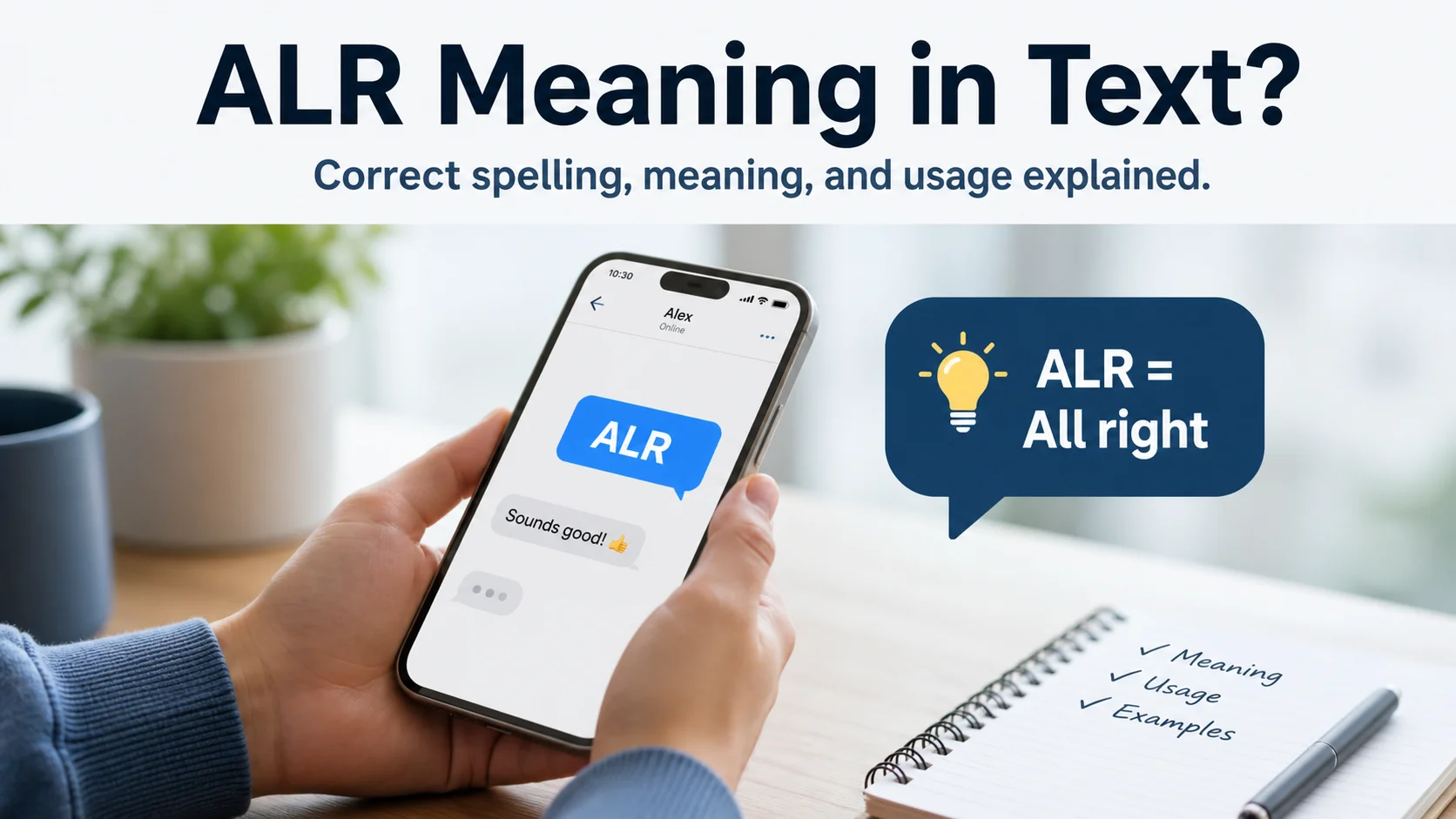
Text slang moves fast. One week a phrase feels fresh. The next week it looks tired. Still, some shortcuts stick around because they do one job very well: they save time. ALR is one of those shorthand terms. You will see it in DMs, group chats, replies, comment threads, and quick back-and-forth messages where speed matters more than polish.
At first glance, ALR meaning in text looks simple. Most of the time, it means “alright”. But like many pieces of internet slang, the real meaning depends on tone, context, and the relationship between the people texting. Sometimes it sounds casual and friendly. Other times it can feel detached, annoyed, or dismissive. That is why understanding ALR matters. It is not just about knowing the definition. It is about knowing how people actually use it.
This guide breaks ALR down in plain English. You will learn what it means, where it fits, how to use it naturally, and when it is better to avoid it. You will also see real examples, platform-based usage, comparison tables, and practical takeaways so you can read texts more clearly and use ALR without sounding awkward.
What Does ALR Mean in Text?
The basic meaning of ALR
In texting, ALR usually means “alright.” It is a shortened form people use to keep messages fast and casual. You will often see it in informal conversations where people want to send a quick reply without typing the full word.
For example:
- “ALR, sounds good.”
- “ALR, I’m on my way.”
- “ALR, no problem.”
In these examples, ALR works like a simple response. It confirms agreement. It signals understanding. It can also show that the person is moving the conversation forward without much extra detail.
That is the main thing to remember: ALR is usually a casual version of alright.
Where ALR comes from
ALR comes from the same texting habit that gave us many other abbreviations. People started trimming words to save time on phones, especially when typing on small screens was slower and more annoying. Over time, those shortcuts became normal in digital conversation.
ALR fits this pattern well because “alright” is common in everyday speech. People already use it as a quick response in real life. Turning it into ALR just makes it even faster.
This kind of slang usually grows in spaces where speed matters:
- SMS texting
- Snapchat chats
- Instagram DMs
- Discord messages
- gaming chats
- comment replies
It is short, flexible, and easy to understand. That is why it survives.
What ALR stands for in different contexts
Most of the time, ALR means alright. However, context matters. In some online spaces, people may use abbreviations in slightly different ways. That said, in normal texting and social media use, ALR almost always points to “alright.”
Here is the simple rule:
- Texting and social media: ALR = alright
- Formal writing: do not use ALR
- Unclear context: read the whole message before assuming tone
Think of ALR like a quick nod. It can mean “okay,” “sure,” “fair enough,” or “I got it,” depending on the conversation.
How People Use ALR in Real Conversations
ALR as “alright” in casual texting
The most common use of ALR is as a quick, casual version of alright. People use it when they want to agree, acknowledge something, or move on.
Examples:
- “ALR, I’ll see you later.”
- “ALR, send me the file.”
- “ALR, that works for me.”
In each case, the phrase keeps things light and simple. It does not demand a big emotional response. It just gets the point across.
This is one reason ALR is so common. It works in conversations where nobody wants to type a full sentence for a small reply. It is the text-message version of a short shrug and a nod.
Tone variations: agreement, acceptance, indifference
ALR is not just a word. It is a tone tool.
Depending on the situation, it can sound:
- Agreeable: “ALR, let’s do it.”
- Accepting: “ALR, I get it.”
- Neutral: “ALR.”
- A little annoyed: “ALR, whatever.”
- Dismissive: “ALR.”
That last part matters. A single word can carry very different feelings. In texting, people often read extra meaning into short replies because there is no voice tone or face-to-face expression. A simple ALR may feel warm to one person and cold to another.
For example:
- “ALR, cool” sounds easygoing.
- “ALR.” with a period can feel more final.
- “ALR then” may sound like the speaker is done with the topic.
Small details matter in text. That is why ALR can be useful and risky at the same time.
Real-life chat examples
Here are some realistic ways ALR appears in everyday messages:
Friendly tone
- A: “Want to grab food at 7?”
- B: “ALR, see you then.”
Neutral tone
- A: “I changed the meeting time to 3.”
- B: “ALR.”
Slightly impatient tone
- A: “You still mad?”
- B: “ALR, let’s just move on.”
Casual agreement
- A: “I’ll send it tonight.”
- B: “ALR, thanks.”
These examples show why context matters. ALR is short, but it is not empty. It usually carries a mood.
ALR Meaning on Different Platforms
TikTok usage and comment culture
On TikTok, ALR often shows up in short comments, reactions, and reply chains. Because TikTok moves fast, people like quick language that lands immediately.
You may see comments like:
- “ALR this is actually true.”
- “ALR that was funny.”
- “ALR but why is this so accurate?”
Here ALR works like a fast agreement marker. It can also soften a response so it feels more casual than “yes” or “exactly.”
TikTok comment culture favors short, punchy language. ALR fits right in. It is compact. It is readable. It feels native to the platform.
Instagram DMs and captions
Instagram DMs often use ALR in relaxed personal chats.
Examples:
- “ALR, I’ll reply later.”
- “ALR, send the address.”
- “ALR, I’m free tonight.”
In captions or comments, ALR can help make a post sound informal and current. People usually use it in a voice that feels close to spoken language.
However, in captions, slang can age quickly. A phrase that feels trendy now may feel stale later. That is why ALR works best when the overall tone already feels casual.
Snapchat streak conversations
Snapchat is one of the most natural places for ALR. The app is built around quick, low-pressure conversations. People often send short messages just to keep a streak alive or confirm plans.
Examples:
- “ALR.”
- “ALR, bet.”
- “ALR, send it.”
On Snapchat, people usually do not expect formal writing. They want fast exchanges. ALR fits the platform’s style because it keeps the conversation moving without extra effort.
Discord and gaming chats
In Discord and gaming chats, ALR is often used to acknowledge plans, strategies, or instructions.
Examples:
- “ALR, I’ll cover mid.”
- “ALR, queue up.”
- “ALR, ready when you are.”
In gaming, clarity matters. But speed matters too. ALR gives both. It says “I understand” without making the message too long.
In team settings, though, tone can matter a lot. A short ALR may feel efficient. It may also feel dismissive if someone needed more support or detail.
Examples of ALR in Sentences
Friendly conversations
Here are some natural examples of ALR in friendly chats:
- “ALR, I’ll meet you after class.”
- “ALR, that movie sounds good.”
- “ALR, I already finished it.”
- “ALR, send me the location.”
These examples feel relaxed and normal. They sound like something you would read in a real text thread.
Short replies
ALR often appears as a stand-alone reply.
Examples:
- “ALR.”
- “ALR, cool.”
- “ALR then.”
- “ALR 👍”
These replies are short enough to fit fast conversation. They often signal that the sender agrees or wants to close the loop.
Slightly annoyed tone examples
ALR can also carry mild irritation.
Examples:
- “ALR, do what you want.”
- “ALR, I said I get it.”
- “ALR, fine.”
- “ALR, let’s not start this again.”
In these cases, the word itself is not rude. The tone comes from context, punctuation, and the surrounding message. A reply like this can feel cold if the conversation was already tense.
Neutral responses
Sometimes ALR is just neutral. No drama. No hidden meaning.
Examples:
- “ALR, thanks for letting me know.”
- “ALR, I’ll check it later.”
- “ALR, sounds good to me.”
This is the safest use. It feels simple and clear.
ALR vs “Alright” vs “Aight”
Formal vs informal usage
ALR, alright, and aight all carry similar meaning in casual settings. The difference is mostly about tone and style.
| Term | Main Meaning | Tone | Best Use |
| ALR | Alright | Casual, quick, sometimes flat | Texts, DMs, chats |
| Alright | Alright | Neutral, clearer, less slang-heavy | Everyday writing and speech |
| Aight | Alright | Very casual, slangy, playful | Informal texts and speech |
Alright is the safest of the three. It works in more situations and does not feel too internet-specific.
ALR is shorter and feels more text-native.
Aight sounds the most relaxed and spoken. It can feel playful, but it may also sound less polished.
Tone differences in texting
Here is the practical difference:
- ALR feels quick and modern.
- Alright feels clearer and more neutral.
- Aight feels extra casual and conversational.
Example:
- “ALR, I’ll do it.” → quick and casual
- “Alright, I’ll do it.” → smoother and more neutral
- “Aight, I’ll do it.” → informal and relaxed
If you want to avoid misunderstanding, alright is usually safer. If you want a quick reply that sounds native to texting, ALR works well.
When each one feels natural
Use ALR when:
- the chat is casual
- you want speed
- the conversation is informal
Use alright when:
- you want a clearer reply
- tone matters
- the chat is not super casual
Use aight when:
- the conversation is very relaxed
- the style is playful
- you know the other person will understand the slang
When You Should Not Use ALR
Professional or work-related chats
Avoid ALR in professional settings unless the workplace culture is extremely casual and the relationship is informal.
For example:
- “ALR, I’ll send the report” may feel too relaxed in a work email.
- “Alright, I’ll send the report” sounds better.
- “I’ll send the report shortly” sounds even more professional.
In work communication, clarity usually matters more than speed. People expect you to sound polished, especially in written messages that may be saved, forwarded, or reviewed later.
Formal emails or messages
Do not use ALR in formal emails, client messages, school communication, or anything that needs a respectful tone.
Bad example:
- “ALR, I understood your note.”
Better example:
- “Alright, I understand your note.”
Even better:
- “Thank you. I understand your note and will follow up accordingly.”
ALR belongs in informal spaces. It does not belong in polished professional writing.
Conversations where clarity matters more than slang
If the message could be misunderstood, use the full word.
For example, if you are confirming an important appointment or discussing sensitive plans, alright is safer than ALR.
Compare these:
- “ALR, fine.”
- “Alright, that works.”
The second version feels clearer and less abrupt. In high-stakes conversations, that difference matters.
Situations where ALR can sound cold or dismissive
Sometimes ALR can come off as dismissive, even when you do not mean it that way.
Examples:
- someone is upset
- someone needs reassurance
- someone is asking a serious question
- someone is looking for detail, not a quick nod
In those moments, ALR may feel like a brush-off. A better response might be:
- “Alright, I understand.”
- “Got it.”
- “That makes sense.”
- “Thanks for explaining.”
Language is not only about meaning. It is also about emotional effect. A short reply can accidentally send the wrong signal.
Common Misunderstandings About ALR
People thinking it means something else
Many slang terms get confused with other abbreviations. ALR is usually pretty straightforward, but people still ask what it means because they are not used to seeing it in text.
The most common misunderstanding is that ALR might mean something more complicated than it does. In reality, it is usually just alright.
This is a good reminder: not every abbreviation hides a secret meaning. Sometimes it is just shorthand.
Confusion with gaming slang
In gaming communities, people often use short forms everywhere. That can make ALR feel more ambiguous to newer players or readers.
Someone might see:
- “ALR, push now”
- “ALR, reset”
If you are new to the chat, the term can seem vague. But once you understand the pattern, it is easy. It is just a quick agreement or acknowledgement.
Misreading tone in messages
This is the biggest risk with ALR.
Because text lacks voice and facial expression, readers often fill in the gaps themselves. A short ALR might seem:
- cool and relaxed
- tired
- annoyed
- passive-aggressive
The truth is often somewhere in the middle. That is why context matters so much. If you are unsure about the tone, read the full message chain instead of focusing on the abbreviation alone.
Is ALR Still Relevant in 2026?
How slang evolves over time
Slang changes constantly. Some abbreviations rise fast and then fade. Others stay around because they are useful. ALR belongs to the second group.
It is short. It is easy to type. It fits casual messaging. Those features keep it alive even as newer slang comes and goes.
Internet language tends to reward phrases that:
- save time
- feel natural
- work across platforms
- do not need explanation
ALR checks all four boxes.
Why ALR is still widely used
ALR survives because people still want quick, low-effort responses. In a world full of notifications, group chats, and endless replies, short forms are practical.
It also works across age groups in informal settings. People may not all use it the same way, but they usually understand it.
A slang term does not have to be flashy to last. Sometimes the plain ones stay strongest.
New alternatives emerging in Gen Z texting culture
Even though ALR is still common, younger users keep testing new styles of expression. Some people prefer:
- emoji reactions
- voice notes
- “bet”
- “fs” for “for sure”
- “k” or “ok” in blunt contexts
- longer, more expressive replies
Still, ALR remains useful because it sits in the middle. It is short without being too rude. It is casual without being confusing.
Pros and Cons of Using ALR in Texting
Pros of ALR
ALR has some clear strengths:
- It saves time.
- It feels natural in casual chats.
- It is easy to understand.
- It works in many digital spaces.
- It can keep a conversation moving.
It also helps you sound relaxed without typing too much. That is useful in fast-moving conversations.
Cons of ALR
ALR is not perfect.
Here are the downsides:
- It can sound blunt.
- It may feel cold in serious conversations.
- It is not good for formal writing.
- It can be misread as annoyed or uninterested.
- Some people may not know it right away.
That last point is important. A message should make life easier, not harder. If the person might not understand the slang, use the full word.
Quick pros and cons table
| Pros | Cons |
| Fast to type | Can sound blunt |
| Easy in casual chats | Not suitable for formal writing |
| Widely understood online | Tone can be misread |
| Works across apps | Not ideal for serious talks |
| Keeps messages short | May feel dismissive |
Best Alternatives to ALR
“Alright”
This is the cleanest alternative. It is simple, neutral, and widely understood.
Use it when you want to sound casual but clear.
Example:
- “Alright, I’ll be there soon.”
“Aight”
This version feels more slangy and spoken. It is common in very casual chats.
Example:
- “Aight, cool.”
Use it with people who already know your style. Otherwise, it can feel too casual.
“Got it”
This one shows understanding. It feels a little warmer and more helpful than ALR.
Example:
- “Got it, I’ll handle that.”
That tiny shift in tone can matter a lot.
“Sure”
Sure is short, simple, and flexible. It can sound positive or neutral depending on context.
Example:
- “Sure, that works.”
It works well when you want agreement without sounding too stiff.
“Okay” or “OK”
These are basic but effective. They are easy to read and hard to misinterpret.
Example:
- “Okay, send it over.”
If you are trying to avoid confusion, this is a safe pick.
How to Use ALR Without Sounding Awkward
Match the other person’s tone
One of the easiest ways to use ALR naturally is to match the tone of the conversation.
If the other person uses short, casual replies, ALR fits right in.
If they write full sentences, ALR may feel out of place.
Think of it like conversation rhythm. Good texting often sounds like both people are on the same wavelength.
Use it in low-stakes conversations
ALR works best when the topic is simple.
Good uses:
- confirming plans
- saying “okay”
- acknowledging a message
- replying casually
Less ideal uses:
- conflict
- formal communication
- emotional support
- important instructions
Add a little context when needed
A bare ALR can feel empty. Adding a few words can make it warmer and clearer.
Compare:
- “ALR.”
- “ALR, sounds good.”
- “ALR, thanks.”
That small addition softens the tone and makes your meaning obvious.
Use punctuation carefully
Punctuation changes tone.
Examples:
- “ALR” = neutral
- “ALR.” = can feel final
- “ALR!” = surprised or energetic
- “ALR?” = confused or checking
- “ALR lol” = casual and friendly
The same three letters can feel very different depending on the rest of the message.
Read More: HYD Meaning in Text?
Case Studies: How ALR Works in Real Situations
Case Study 1: A friend making plans
Scenario: Two friends are planning dinner.
- Friend A: “Can you make it at 8 instead of 7?”
- Friend B: “ALR, yeah that’s fine.”
What ALR does here:
It shows flexibility. It keeps the reply short and casual. It sounds easygoing, not dramatic.
Why it works:
The topic is simple. The relationship is informal. No extra explanation is needed.
Case Study 2: A tense conversation
Scenario: Someone is upset about a delayed response.
- Person A: “You never answer on time.”
- Person B: “ALR.”
What ALR does here:
It may sound dismissive or defensive, even if that was not the intention.
Why it is risky:
In tense conversations, short replies can feel cold. The person may think you do not care.
Better version:
“Alright, I understand. Sorry about that.”
Case Study 3: A gaming team chat
Scenario: A team is organizing a match.
- Player A: “Hold back until I call push.”
- Player B: “ALR.”
What ALR does here:
It shows quick understanding. It keeps the team chat clean and fast.
Why it works:
Gaming chats reward short confirmation. Everyone already knows the context.
Case Study 4: A work message
Scenario: A manager sends an update.
- Manager: “Please send the revised document by 4 PM.”
- Employee: “ALR.”
What ALR does here:
It may feel too casual, depending on workplace culture.
Better version:
“Alright, I’ll send it by 4 PM.”
or
“Understood. I’ll send it by 4 PM.”
In professional communication, clarity usually wins.
How to Read ALR in Someone Else’s Message
Look at the message before and after it
A single ALR does not tell the whole story. Read the nearby messages first.
Ask:
- What was the topic?
- Was the conversation friendly?
- Was the other person annoyed?
- Did they use short replies before this?
That context usually reveals the real tone.
Notice punctuation and spacing
A period can make ALR feel sharper. An exclamation mark can make it feel more upbeat. No punctuation often feels neutral.
For example:
- “ALR” = plain
- “ALR.” = final
- “ALR!” = enthusiastic
- “ALR?” = uncertain
Pay attention to timing
A delayed ALR can feel different from a fast one. If someone replies with a short ALR after a long pause, it may feel cooler or less engaged.
That does not always mean they are angry. Sometimes they are just busy. Still, timing shapes tone.
Consider the relationship
Friends, siblings, classmates, coworkers, and strangers all use slang differently.
A message that sounds normal from one person may sound rude from another. Relationship matters just as much as wording.
ALR in Everyday Speech vs Texting
Spoken use
People may say “alright” in speech much more often than they type ALR. In spoken conversation, the abbreviation itself is less common because people naturally use the full word.
For example:
- “Alright, let’s go.”
- “Alright, I’ll do it.”
Texting use
In texting, ALR replaces the full word because it is faster and more casual.
This is the key difference:
- Speech: usually “alright”
- Text: often “ALR”
So the written form feels like a digital shortcut, not a separate word with a new definition.
Common ALR Mistakes to Avoid
Using it in the wrong setting
Do not use ALR in:
- job applications
- school essays
- business emails
- formal letters
- serious messages
Using it when clarity matters
If you need to sound respectful or precise, spell out the full phrase.
Better to write:
- “Alright, I understand.”
than - “ALR.”
Assuming everyone reads it the same way
Some people see ALR as neutral. Others see it as cold. Always think about the person reading it.
Overusing slang
If every message is full of shorthand, your writing can start to feel lazy or unclear. Slang works best in balance.
A little goes a long way.
Quick Reference: ALR at a Glance
| Feature | Details |
| Meaning | Usually “alright” |
| Style | Casual texting slang |
| Tone | Neutral, friendly, or blunt depending on context |
| Best used in | DMs, texts, social media, gaming chats |
| Avoid in | Formal writing, professional messages, serious discussions |
| Main risk | Can sound dismissive or cold |
A Simple Rule for Using ALR
Here is the easiest way to decide:
- If the chat is casual, ALR is fine.
- If the chat is important, use alright or a fuller reply.
- If the chat is tense, choose something warmer and clearer.
- If you are not sure, spell it out.
That one rule will save you from most mistakes.
FAQs:
Does ALR mean alright or something else?
Most of the time, ALR means alright. In normal texting and social media use, that is the standard meaning.
Is ALR rude in texting?
Not always. It can be neutral or friendly. But in some situations, especially tense ones, it can sound short or dismissive.
Who uses ALR the most?
ALR is common among people who text a lot in casual settings, especially on apps like Snapchat, Instagram, Discord, and TikTok.
Can ALR be used in formal writing?
No. It belongs in informal conversation, not formal writing or professional communication.
Is ALR still popular in 2026?
Yes. It still appears in casual digital conversations because it is short, simple, and easy to understand.
Conclusion:
ALR meaning in text is simple on the surface. It usually means alright. But the real story goes deeper than the definition. In texting, ALR can sound friendly, neutral, lazy, impatient, or even a little cold, depending on how and where people use it. That is why context matters so much.
If you are chatting with friends, ALR is a handy shortcut. It keeps things fast and natural. If you are writing something formal, serious, or emotionally sensitive, though, it is better to spell things out. A small word choice can change the whole feel of a message.
The safest approach is easy: use ALR in casual conversations, avoid it in formal ones, and always read the tone before you send it. That way, you stay clear, natural, and easy to understand.
