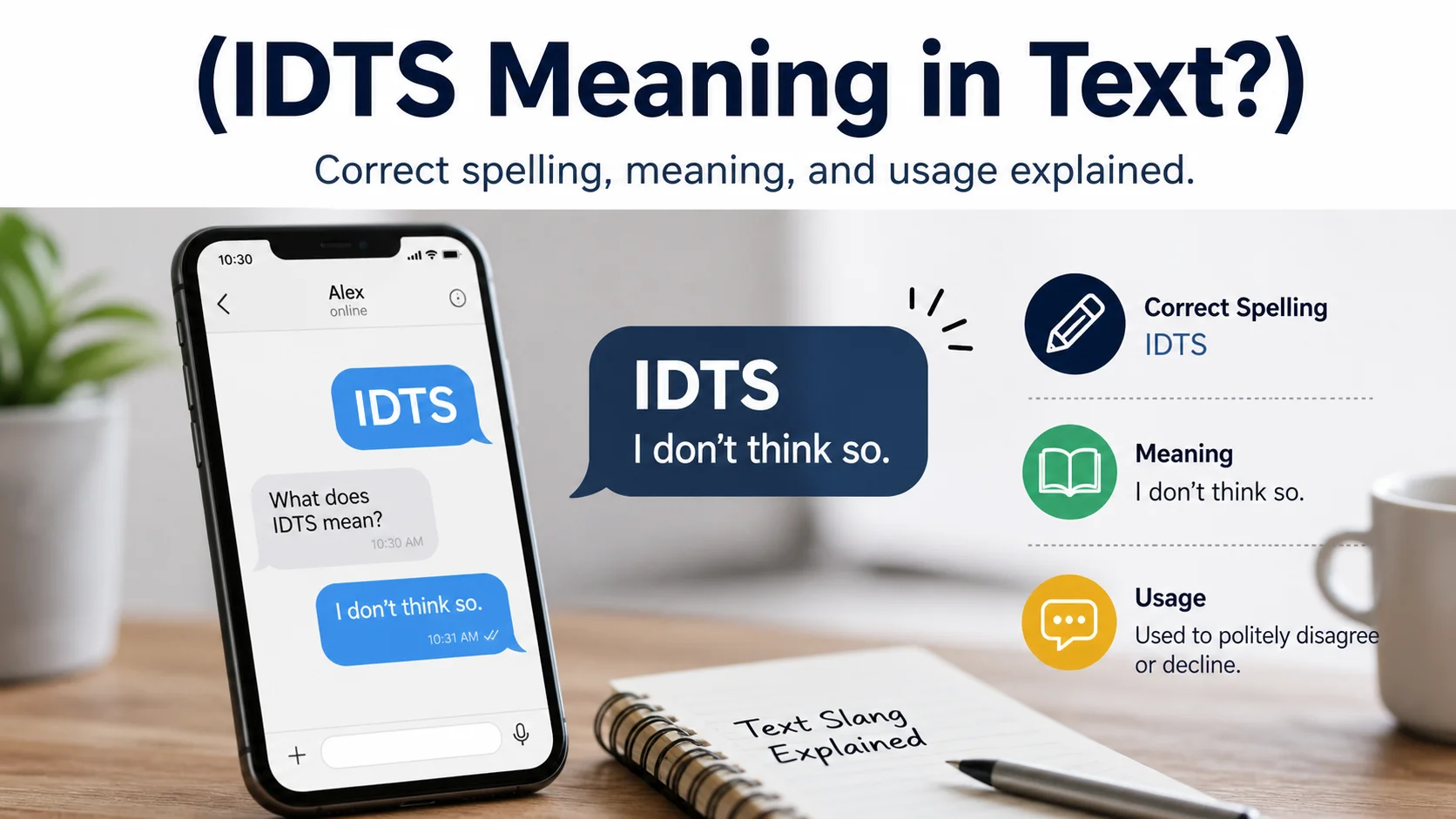
Have you ever been texting a friend or scrolling through social media and suddenly seen IDTS Meaning in Text? It often appears in social media, chats, and DMs, making people feel confused. In my own experience, when I first saw IDTS, I paused in a conversation and felt real confusion because modern text slang works like a secret language that even experienced texters sometimes struggle to understand.
This guide explains the meaning in text, its origin, and real examples so you don’t feel stuck again. When someone sends IDTS, your reaction is usually confusion, especially in fast chats or professional conversations. Over time, texting changes quickly, and you may feel stuck guessing meanings, but learning it helps you respond confidently, avoid misunderstanding, and use alternatives when needed in simple, clear human communication.
IDTS Meaning in Text (Full Breakdown)
Let’s go deeper than the surface.
Core Meaning
- IDTS = I Don’t Think So
- Used to express:
- Disagreement
- Doubt
- Rejection
Simple Examples
- “Will it rain today?” → IDTS
- “Is she coming back?” → IDTS
- “Should I buy this?” → IDTS
What Makes IDTS Unique?
Unlike longer replies, IDTS is:
- Quick → Saves time
- Neutral by default → Tone depends on delivery
- Flexible → Works in many situations
Think of it like a digital shrug. It says “probably not” without much explanation.
Why People Use IDTS Instead of Full Sentences
Short answer? Speed.
Long answer? It reflects how people communicate today.
Modern Texting Habits
People don’t write full sentences anymore. They trim everything down. Words become shortcuts. Sentences become fragments.
Here’s why:
- Faster typing
- Mobile-first communication
- Short attention spans
- Casual tone preference
Instead of typing:
“I don’t think that’s going to happen.”
People just write:
IDTS
It feels natural. It sounds like how people actually talk.
How IDTS Is Used in Real Conversations
This is where most articles fall short. They define the term but skip real usage.
Let’s fix that.
Casual Chat Examples (Realistic Texting)
Example 1: Planning with Friends
Friend: “Movie tonight?”
You: “IDTS, I’m tired”
Example 2: Guessing Outcomes
Friend: “Do you think he’ll call?”
You: “IDTS lol”
Example 3: Light Disagreement
Friend: “This place has the best pizza”
You: “IDTS, you haven’t tried Joe’s”
Tone Breakdown: Why Context Matters
Tone changes everything.
Let’s compare:
| Message | Interpretation |
| IDTS | Neutral or slightly cold |
| IDTS lol | Light, playful |
| IDTS… | Hesitant or unsure |
| IDTS 😒 | Annoyed or dismissive |
| IDTS, sorry | Polite disagreement |
Same words. Different emotional signals.
Emoji Impact (Small Detail, Big Difference)
Adding an emoji can completely change how IDTS feels.
- IDTS 🙂 → Friendly
- IDTS 😂 → Joking
- IDTS 😑 → Dry, uninterested
- IDTS 😬 → Awkward
Think of emojis as tone indicators. Without them, messages can feel blunt.
IDTS Meaning on Social Media (Platform-Specific Use)
Different platforms shape how people use language.
Let’s break it down.
On TikTok
- Often used in comments
- Usually sarcastic or humorous
- Paired with trending jokes
Example:
“This trend will last forever”
Comment: “IDTS 💀”
On Snapchat
- Fast replies
- Minimal effort
- Often used without punctuation
Example:
“You coming?”
“idts”
On Instagram DMs
- Casual conversations
- Used in reactions to stories
Example:
“Should I post this?”
“IDTS”
On Discord
- Gaming chats
- Group discussions
- Debate-style conversations
Example:
“We can win this match”
“IDTS bro”
IDTS vs Similar Slang (Don’t Mix These Up)
Many people confuse IDTS with other abbreviations. That leads to awkward conversations.
Here’s a clear comparison:
| Slang | Full Meaning | Tone | Best Use Case |
| IDTS | I don’t think so | Neutral to firm | Disagreement |
| IMO | In my opinion | Neutral | Sharing views |
| IDC | I don’t care | Harsh | Indifference |
| NVM | Never mind | Dismissive | Dropping topic |
| TBH | To be honest | Honest, direct | Giving opinions |
Quick Tip
If you want to disagree politely, IDTS works better than IDC. One sounds thoughtful. The other sounds rude.
When to Use IDTS (And When to Avoid It)
Knowing the meaning isn’t enough. You need to know when to use it.
Best Situations to Use IDTS
Use it when:
- You’re chatting with friends
- The topic is casual
- You want a quick reply
- The conversation isn’t serious
When You Should Avoid IDTS
Avoid it in:
- Work conversations
- Professional emails
- Serious discussions
- Emotional topics
Example of Wrong Usage
Boss: “Can you finish this today?”
You: “IDTS”
That feels careless.
Better:
“I don’t think I can finish it today, but I’ll try.”
How to Respond to IDTS (Smart Replies That Work)
Getting “IDTS” as a reply can feel confusing. Is it a no? A maybe? A joke?
Here’s how to respond without overthinking.
If You Want to Continue the Conversation
Ask for more detail:
- “Why not?”
- “What makes you say that?”
- “You sure?”
If You Want to Keep It Light
Stay casual:
- “Haha fair enough”
- “Alright 😄”
- “No worries”
If It Feels Rude
Keep your tone calm:
- “Got it, thanks”
- “All good 👍”
- “Just checking”
If You Want to Change Their Mind
Push gently:
- “Hear me out…”
- “Just give it a chance”
- “You might like it”
Real-Life Case Studies: IDTS in Action
Let’s look at real scenarios.
Case Study 1: Friendly Debate
Situation: Two friends discussing a movie.
Chat:
- A: “That movie was amazing”
- B: “IDTS, it was boring”
Analysis:
- Tone = mild disagreement
- Not rude
- Normal conversation
Case Study 2: Dating Scenario
Chat:
- A: “Should I text him again?”
- B: “IDTS…”
Analysis:
- Tone = cautious advice
- The “…” adds hesitation
- Feels thoughtful, not harsh
Case Study 3: Group Chat Planning
Chat:
- Friend 1: “Let’s go hiking tomorrow”
- Friend 2: “IDTS lol”
Analysis:
- Tone = playful rejection
- “lol” softens the message
Read This: OTW Meaning in Text?
Is IDTS Rude? (Clear Answer)
Short answer: It depends.
What Makes IDTS Sound Rude
- No explanation
- No emoji
- Serious context
- One-word reply
What Makes It Sound Polite
- Added context
- Friendly tone
- Emojis
- Soft wording
Comparison Example
| Version | Tone |
| IDTS | Cold |
| IDTS lol | Friendly |
| IDTS, sorry | Polite |
| I don’t think so, maybe later | Warm |
Golden Rule
If the situation matters, don’t rely on abbreviations.
IDTS Meaning from a Girl vs a Guy
Let’s clear this up honestly.
It’s not really about gender. It’s about communication style.
General Patterns (Not Rules)
- Some people use:
- Emojis
- Extra words
- Softer tone
- Others prefer:
- Short replies
- Direct language
Example Comparison
Version A:
“IDTS 😅 maybe another time”
Version B:
“IDTS”
Same meaning. Different delivery.
Key Insight
Don’t overanalyze who sent it. Focus on the context instead.
Common Mistakes People Make with IDTS
Avoid these if you want smoother conversations.
1. Using It in Formal Situations
Never use IDTS in professional emails.
2. Misreading the Tone
Not every “IDTS” is rude.
3. Overusing It
Repeating it too often makes conversations feel dry.
4. Ignoring Context
Always read the full conversation before reacting.
Quick Summary (TL;DR)
- IDTS means “I Don’t Think So.”
- It’s used in casual texting
- Tone depends on context
- Emojis can soften it
- Avoid using it in formal settings
FAQs :
1. What does IDTS mean in text?
IDTS means “I Don’t Think So,” used in chats and social media to politely disagree or show doubt.
2. Where do people use IDTS most?
It is commonly used in social media, texting apps, DMs, and online conversations.
3. Is IDTS formal or informal?
It is mostly informal and used in casual text slang conversations, not in professional writing.
4. Why do people get confused by IDTS?
Because modern text slang changes fast, and abbreviations like IDTS feel like a secret language.
5. Can IDTS be used in professional chats?
It’s better to avoid it in formal or professional conversations, and use full sentences instead.
Conclusion :
Understanding IDTS Meaning in Text helps you avoid confusion in daily conversations, especially on social media, chats, and DMs. Once you know it means disagreement or doubt, you can respond more clearly and confidently. Learning such text slang makes communication smoother and helps you stay updated with fast-changing online language without feeling lost.
